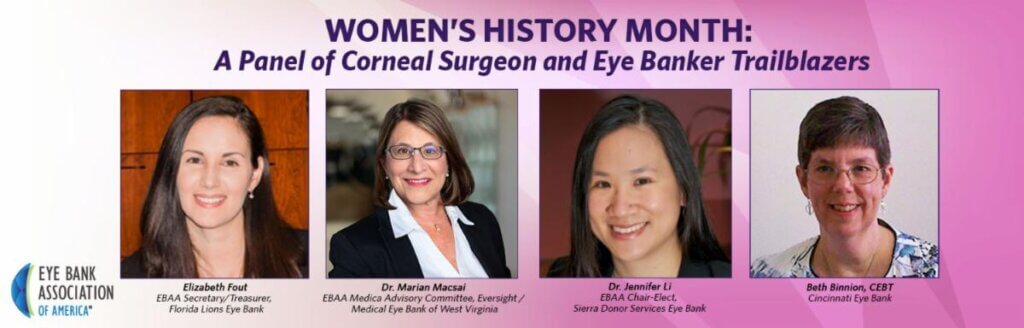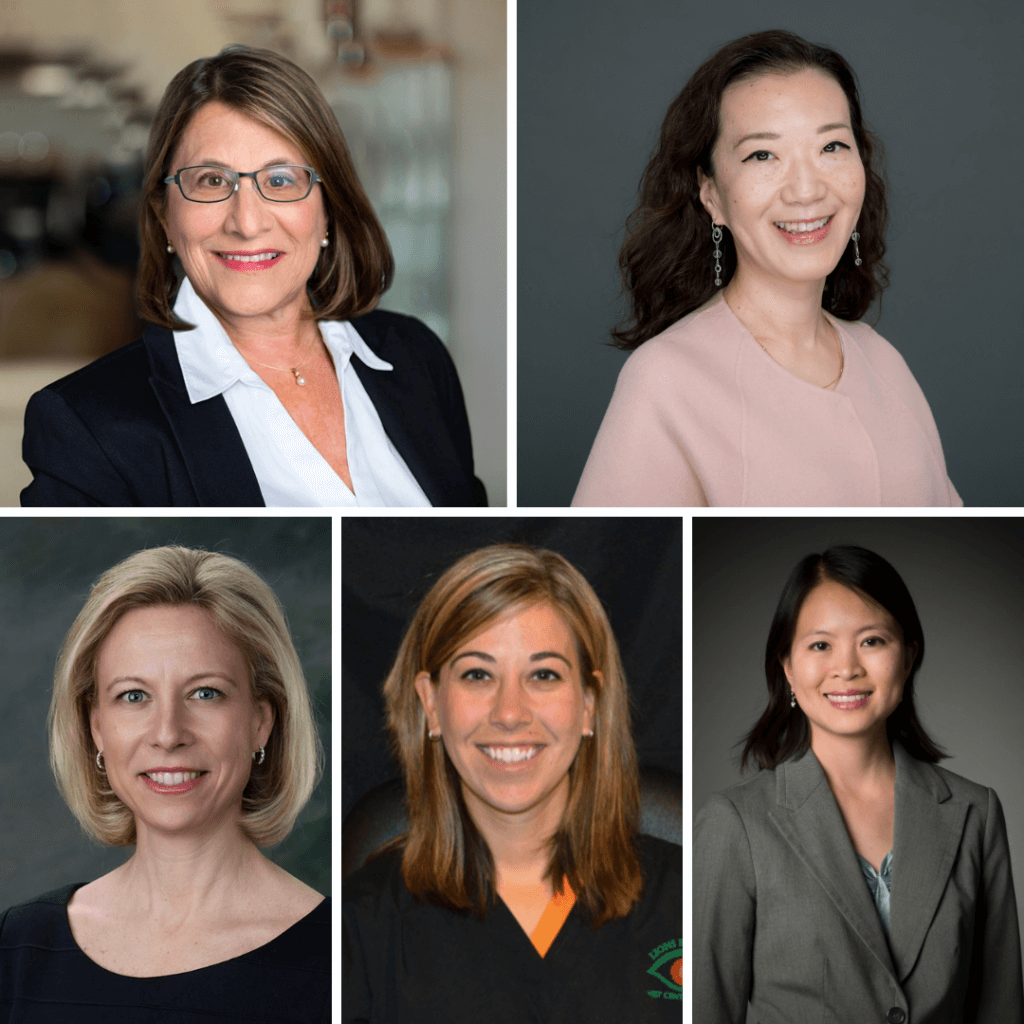
March is Women’s History Month, a celebration of women’s achievements in American history. This month and all year round, EBAA honors women in eye banking – not just those in the past, but women committed to the restoration of sight today, and to the future of eye banking.
Women’s History Month Spotlight
Marianne Price, Ph.D.
Cornea Research Foundation of America, Executive Director
2025 R. Townley Paton Award Recipient

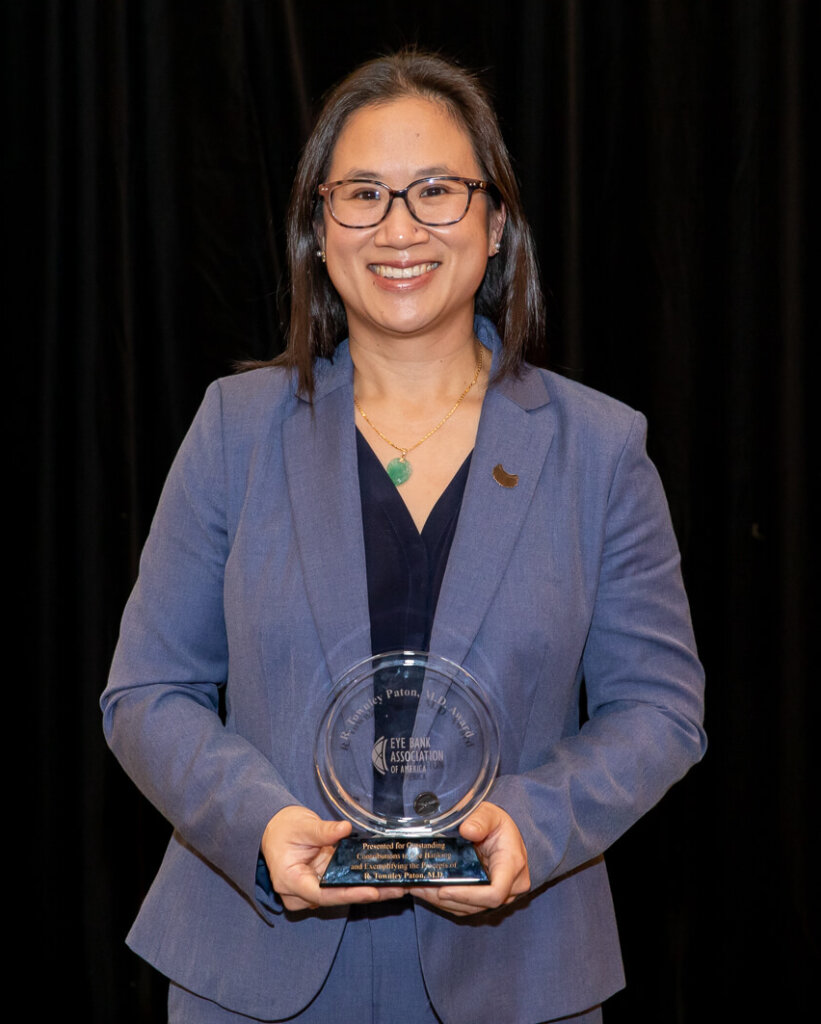
Marianne Price, Ph.D. is the recipient of the 2025 R. Townley Paton Award, the Eye Bank Asociation of America’s highest honor for physicians. Her Paton Lecture, “Disruption in Cornea: Lessons from the Past, Vision for the Future” is available to watch for free on EyeLearn.
Marianne Price, Ph.D. is a trailblazer, although she doesn’t think of herself that way, and she’d certainly never call herself that. However, some things are undeniable, and being the first woman (and Valedictorian) to graduate from the University of Notre Dame with an engineering degree – the only woman in her 400+ person chemistry class—is no small feat.
Marianne attended a small all-girls Catholic high school in Nashville, TN. When she was starting to consider college options, the school was visited by a representative from Vanderbilt University who encouraged the students to consider engineering. Since she was always good at science, this perked Marianne’s interest.
“At the time there were very few women in engineering,” Marianne says. “Women tended to gravitate more to people-focused sciences like biology.”
She graduated in 1970, and enrolled at Notre Dame because it was Catholic and in driving distance of home. One of only 325 women in the university’s first co-ed class, she describes her time at Notre Dame as “exciting” and part of the appeal was being a “pioneer” at a formerly all-male school.
While she doesn’t recall being intimidated by this situation, she describes varying reactions from male classmates. She says, “Some were encouraging, while others seemed to feel threatened.”
Overall, Marianne describes college as, “An amazing experience with great mentors and friends—a real positive.” Interestingly, her younger sister followed in her footsteps to Notre Dame six years later. Marianne thinks her sister faced more opposition than she did, because as the number of spots allocated for women increased over time, the available spots for men decreased, making it harder to get in.
Notably, Marianne met her husband of 51 years at Notre Dame, Francis W. Price, Jr. M.D. They married shortly after graduation, and over time had four children. Marianne worked 15 years as an engineer, working part-time while raising children, and leaving after the birth of her youngest. While deciding what to do when the youngest started kindergarten, she visited a career counselor who suggested that she pursue a career in human genetics or biotechnology.
Marianne enrolled back in school and earned a doctorate in Medical and Molecular Genetics from Indiana University. Her graduate experience included many more women than her undergrad, as it had a medical focus.
After earning her Ph.D. in 2001, her husband’s Cornea Research Foundation needed a director, so Marianne filled the role, as the timing was just right. When asked about working with her spouse, Marianne says, “We enjoy working and going to meetings together. We have complimentary skills – he’s the ‘risk taker’ and I’m a detail-oriented scientist who focuses on study design and execution to produce reliable outcomes.”
She drew upon her engineering background for her work in cornea. “The subject matter is different but both areas benefit from an analytical approach to solving problems,” she says.
Marianne and Frank’s youngest son is an ophthalmologist and joined their practice in July. Marianne is looking forward to hiring a new Director for the Foundation and would like to remain involved on the scientific side while spending more time with grandchildren and friends.
With so many ways to contribute in science available today, she encourages young people to “Get out and try new things to find out what you’re good at and what sparks your interest. Meet new people, participate in sports, a summer job, or shadowing experiences. Engaging in person is far more rewarding long-term than virtual experiences or scrolling the phone.”
Looking to the future of cornea, she’s excited to see better treatments being developed and new advances for difficult-to-treat conditions. The biggest challenge she sees is reimbursement, “What we’re spending on healthcare is not sustainable but change is difficult because the system is so complicated. Affordability is a big concern.”
We’re grateful to Marianne and all the women who blaze a trail for others, while juggling life’s complications and pursuing EBAA’s mission to restore sight worldwide.
Aida Breckinridge
First Executive Director of The Eye-Bank for Sight Restoration, and eye banking trailblazer
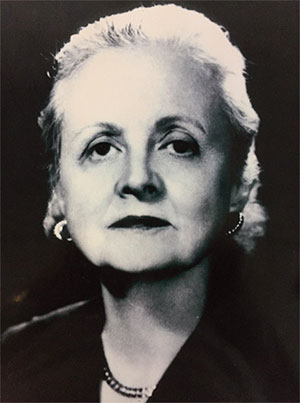
A woman of many roles, Aida Breckinridge is best known as the first Executive Director of the nation’s first eye bank, The Eye-Bank for Sight Restoration in New York City.
Working in conjunction with the “Father of Modern Eye Banking”, Dr. R. Townley Paton, her revolutionary efforts beginning in 1944 were the seed that has grown into more than 2 million sight restoring corneal transplants today.
Born Aida de Acosta in 1884, Breckinridge became an advocate for the gift of sight after developing glaucoma. Treated by famed ophthalmologist William H. Wilmer, her sight was saved and she was inspired to help others preserve their vision. Known as a “PR powerhouse,” she tapped into her vast network of contacts, organizing a fundraising campaign which raised $3 million (roughly $53 million today!) by 1925. This money funded The Wilmer Ophthalmological Institute at Johns Hopkins University, a teaching and research center, and the first eye institute in the country.
Following these successful efforts for Wilmer, Aida was approached by Dr. Paton – one of Wilmer’s former students, who discussed with her the founding of an eye bank. Together they established a facility for eye donations, with Breckinridge heading up fundraising, education, and organizational efforts. The Eye-Bank for Sight Restoration was incorporated in 1945, headquartered at the Manhattan Eye, Ear, and Throat Hospital.
Breckinridge enlisted the support of influential people and obtained The Eye-Bank’s start up funding from the Milbank Foundation. Their original Council included Albert Milbank, Thomas Watson (founder of IBM), Senator Harry F. Byrd, and former President Herbert Hoover. Five former First Ladies also joined, including Eleanor Roosevelt.
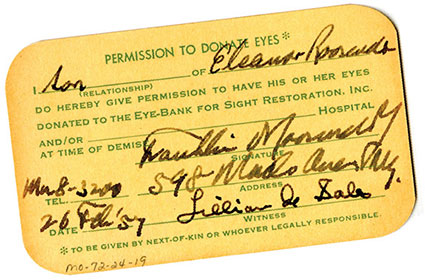
Amongst her many contributions in laying the groundwork for eye banking, she tackled the difficulties securing and transporting donated corneas for transplant by gaining publicity for eye donation, putting into use eye-donor pledge forms, and enlisting airlines as well as the American Red Cross to transport tissue for transplanting tissue.
Understanding the “power of the press”, Breckinridge created the first educational brochure on eye donation for the public with the help of the J. Walter Thompson Advertising Agency, titled, “A Gift Like the Gifts of God.” Other notable press mentions were emotional stories of patients receiving the gift of sight and explaining cornea transplantation in layman’s terms; these were featured in The New York Times Magazine and Reader’s Digest. The Reader’s Digest article was later carried in the seat pockets of every Eastern Airlines flight.
Breckinridge led The Eye-Bank for ten years, retiring in 1955. She died in 1962, leaving a legacy of countless lives transformed by the gift of sight, owed in many ways to her successful efforts in helping to fund, organize, and establish eye banking as we know it today.
Women at EBAA Today
Right now is a significant time for women at EBAA:
- The EBAA Board of Directors is evenly split between men and women. The Immediate Past Chair and Speaker of the House are both women.
- 81% of EBAA committee chairs are women.
- 46% of EBAA-Member eye bank Executive Directors are female.
- The EBAA staff, with the exception of President & CEO, Kevin Corcoran, is female.
EBAA Women’s History Resources
EBAA has resources to learn more about women in eye banking, ophthalmology, corneal transplantation, and the association itself.